Finasteride is a clinically proven treatment for hair loss in men, available in two forms: oral tablets (FDA-approved at a dose of 1 mg/day) and compounded topical formulas. In this article we cover the essential information you need to understand the differences between these forms, including answers to two important questions: is one stronger or more effective than the other, and is there a difference in side effects? As topical finasteride becomes more and more popular, it's important to understand the benefits and possible risks and to decide together with a doctor whether it's an option for treating your hair loss.
Worried about side effects of finasteride? You're not the only one.
There are options that can help with hair loss while lowering the risk of side effects. Talk to a doctor today.
What is finasteride?
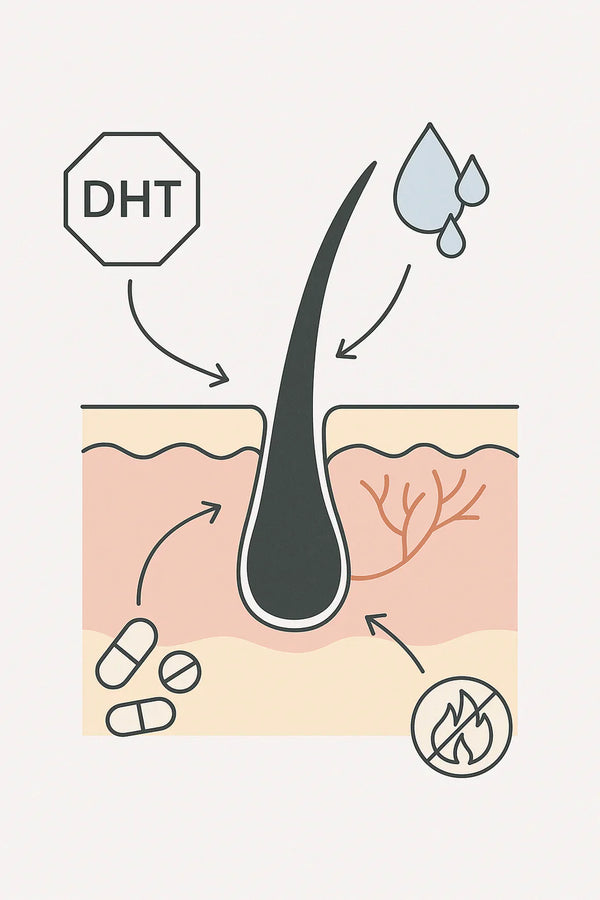
Finasteride is a type of medicine called a 5-alpha-reductase inhibitor (5-ARI). It works by preventing part of the testosterone in your body from being converted into a closely related hormone called dihydrotestosterone (DHT). In men who are genetically predisposed to hereditary baldness, high DHT levels can make hair follicles shrink and stop producing hair. This leads to the typical thinning and balding that people associate with this form of hair loss. Finasteride can help slow this process by keeping DHT levels low, and the medicine helps maintain these lower levels as long as you keep using it.
The safety and effectiveness of finasteride have been studied in countless studies since the medicine was first approved for treating hair loss. It works well because it tackles the underlying cause of hair loss, but as with other medicines there are safety risks you should be aware of. Read our article on the side effects of finasteride for more information.
Finasteride can be prescribed as a 1 mg oral tablet or as a compounded topical medicine. Compounded treatments are not FDA-approved, but can contain FDA-approved ingredients (in this case finasteride). They can differ in form and strength from FDA-approved treatments and are made to measure to meet patients' needs. There are currently no standards for the type of formula (e.g. solution, gel, foam) or the concentration of topical finasteride, so it's important to research the possible benefits and risks of the topical treatment you are considering.
At KÁDESO Labs we offer topical finasteride that is applied directly to the scalp. Finasteride works the same way in all formulas, but different forms of administration can affect how much finasteride is absorbed into the body, which in turn can affect the risk of side effects.
Is oral finasteride stronger than topical?
Not necessarily. In some cases topical finasteride can be prepared with a higher concentration of finasteride, making it a "stronger" treatment because it contains more finasteride per dose.
We know that the oral tablet contains exactly 1 mg of finasteride. With a simple calculation you can work out how many milligrams are in a bottle of topical finasteride (for that you need to know the concentration and the volume of your bottle), but there's a catch: the amount that actually reaches the hair follicles may not match this exact number. Let us explain why.
When you take oral finasteride, it has to pass through the digestive system and is partly processed by the liver before the medicine reaches the hair follicles. During this process part of the finasteride is broken down or removed from the body. A similar but different process takes place after you apply topical finasteride, only this time part of the medicine is lost while penetrating the skin. That's why it's generally advised not to compare the strength of oral and topical medicines directly, because the way these medicines are metabolised (broken down) differs greatly.
Is topical finasteride better than oral?
Stronger isn't necessarily better. With any medicine, higher doses can also increase the risk of certain side effects if more medicine is absorbed into the bloodstream. Topical application is generally associated with a lower risk of systemic side effects, because the treatment is applied directly to the skin instead of taken by mouth.
 Topical FinasterideReady to start? Click here.→
Is the finasteride pill more effective at stopping hair loss than topical?
Not necessarily, but we do have more data on the effectiveness of oral finasteride. Fortunately there is a growing body of research into the effectiveness of topical finasteride as a possible alternative for patients worried about possible side effects.
A recent 2021 study of male patients aged 18 to 40 with mild to moderate hereditary baldness tested a 0.25% topical finasteride spray against oral finasteride and a placebo (Piraccini et al., 2021). After 24 weeks of treatment, the patients using topical finasteride showed a significant improvement in hair count compared with the placebo group (an average change from baseline of 20.2 hairs versus 6.7 hairs). This improvement was comparable to the group of patients given oral finasteride (20.2 hairs versus 21.1 hairs).
An earlier 2009 study included 45 male patients with hereditary baldness and compared a 1% topical finasteride gel with oral finasteride (Hajheydari et al., 2009). The study found that after 6 months of treatment the total hair count increased significantly in both treatment groups. The researchers concluded that oral and topical finasteride were similarly effective. To date there are no studies comparing the long-term effectiveness of oral versus topical finasteride, but some data show that long-term use of finasteride (in general) can have a positive effect on preventing further hair loss (Yanagisawa et al., 2019).
Several factors can influence the effectiveness of a hair loss treatment, including adherence (how consistently you take or use your medicine), the severity of your hair loss, or even genetic differences in how your body metabolises certain medicines. It's not unusual for doctors to recommend adding different, complementary treatments (such as minoxidil) to increase the effectiveness of a treatment plan, by tackling other causes of hair loss or suboptimal hair growth.
Looking for an alternative solution for hair loss?
If you're worried about side effects, topical finasteride may be an option. Contact a doctor to find out more.
Is topical finasteride safer than the pill?
Possibly, but remember: there is no standard form of administration or concentration for topical finasteride, so the safety of topical formulas can vary greatly. In general, topical medicines are associated with a lower risk of side effects than oral medicines, because the former carry a lower risk of absorption into the bloodstream. Finasteride that is absorbed into the body can affect DHT levels and cause unwanted effects in tissues that are sensitive to hormonal changes.
The most common type of side effects of finasteride use are sexual side effects, including:
- Erectile dysfunction
- Reduced libido (sexual desire)
- Ejaculation disorders
Side effects such as breast pain and/or tenderness or unusual discharge from the breast have also been reported, alongside mood or psychiatric changes, including depression and in extreme cases suicidal thoughts. When comparing the side effects of topical and oral finasteride, it's important to understand that the topical form doesn't rule out the possibility of side effects, but can lower this risk. There are study data supporting that topical finasteride does not increase the risk of systemic side effects, although local skin irritation can occur because the treatment is applied directly to the skin (Lee et al., 2018).
This area would benefit from further research, because the findings have not always been consistent. One study analysed and compared DHT levels in patients after 1 week of treatment with a 0.25% topical finasteride solution and 1 week of treatment with oral finasteride, and found that DHT was suppressed similarly (Caserini et al., 2014). However, a separate study that also compared a 0.25% topical spray with oral finasteride found that after 24 weeks of treatment, oral finasteride lowered DHT levels about 20% more than the topical spray (Piraccini et al., 2021). It's worth noting that not all patients with changes in DHT actually experience side effects, but how significant these hormonal changes are can be an indication of how well a topical formula keeps finasteride out of the body.
Can oral and topical finasteride be used together?
There isn't much data on whether using oral and topical finasteride together improves results or limits side effects. Some people try this assuming they'll get the benefits of both, and in very specific situations a doctor may consider this route for a patient, but using both can cause the very side effects users want to avoid. If you decide to try both, talk to a doctor first, so they can monitor you in case you get side effects.
Topical FinasterideReady to start? Click here.→
Does topical finasteride end up in the body (systemically)?
It can. As mentioned earlier, there are no topical carriers that completely prevent the absorption of finasteride, and different formulas can vary in how well they limit systemic exposure to finasteride.
KÁDESO Labs' topical finasteride is applied directly to the scalp, in the areas where the treatment is needed most. By applying it locally instead of taking a tablet, less active ingredient generally ends up in the bloodstream. If you are particularly concerned about systemic exposure, you can discuss with a doctor which concentration suits you best.
Can I switch from oral to topical finasteride?
In many cases, yes. If you already use oral finasteride and want to switch to a topical formula, the first step is to contact your prescribing doctor. They will weigh your medical history and how you have responded to oral finasteride to decide whether you can switch safely.
Patients can sometimes experience more shedding when switching hair loss treatment (even with a change in strength or concentration). This is because the hair follicles move into a new hair growth cycle. Usually this shedding is temporary and resolves by itself over a few weeks. If the shedding doesn't go away or gets worse, contact your prescribing doctor.
Once you have received a prescription and your treatment, simply apply the topical finasteride according to the instructions on your prescription.
Conclusion: oral vs. topical finasteride
As topical finasteride becomes an increasingly popular option for treating hair loss, we want to make sure you have the information you need to make a well-considered decision. Oral finasteride and topical finasteride treat thinning hair in the same way: by blocking the production of DHT and so preventing the hormone from attacking the hair follicles and hair loss from progressing. Research into the effectiveness of topical finasteride is growing, and the available data suggest it can be just as effective as the oral tablet in promoting hair growth. But because topical finasteride is not FDA-approved, there are no strict guidelines for the concentration of finasteride or the type of carrier (gel, solution, foam, etc.). This means there can be considerable variation in effectiveness, and possibly safety, between different topical finasteride formulas.
The biggest difference between oral and topical finasteride lies in the possible degree of systemic exposure to finasteride. Topical medicines are associated with lower exposure to the medicine, because they are applied directly to the skin. As a result the risk of developing systemic side effects may be lower, and this appears to be supported by some clinical studies that report fewer cases of sexual side effects in patients treated with topical finasteride. Topical finasteride can be a solution for patients who want to benefit from the effectiveness of finasteride but are worried about possible side effects.
Ready for the next step? Start a consultation with a hair loss specialist today to find out whether topical finasteride can help you get closer to your hair goals.
Topical FinasterideReady to start? Click here.→
References
Caserini, M., Radicioni, M., Leuratti, C., Annoni, O., & Palmieri, R. (2014). A novel finasteride 0.25% topical solution for androgenetic alopecia: pharmacokinetics and effects on plasma androgen levels in healthy male volunteers. International Journal of Clinical Pharmacology and Therapeutics, 52(10), 842–849. https://doi.org/10.5414/CP202119
Hajheydari, Z., Akbari, J., Saeedi, M., & Shokoohi, L. (2009). Comparing the therapeutic effects of finasteride gel and tablet in treatment of the androgenetic alopecia. Indian Journal of Dermatology, Venereology and Leprology, 75(1), 47–51. https://doi.org/10.4103/0378-6323.45220
Lee, S. W., Juhasz, M., Mobasher, P., Ekelem, C., & Mesinkovska, N. A. (2018). A Systematic Review of Topical Finasteride in the Treatment of Androgenetic Alopecia in Men and Women. Journal of Drugs in Dermatology: JDD, 17(4), 457–463.
Piraccini, B. M., Blume-Peytavi, U., Scarci, F., Jansat, J. M., Falqués, M., Otero, R., Tamarit, M. L., Galván, J., Tebbs, V., Massana, E., & Topical Finasteride Study Group (2022). Efficacy and safety of topical finasteride spray solution for male androgenetic alopecia: a phase III, randomized, controlled clinical trial. Journal of the European Academy of Dermatology and Venereology: JEADV, 36(2), 286–294. https://doi.org/10.1111/jdv.17738
Yanagisawa, M., Fujimaki, H., Takeda, A., Nemoto, M., Sugimoto, T., & Sato, A. (2019). Long-term (10-year) efficacy of finasteride in 523 Japanese men with Androgenetic Alopecia. Clinical Research and Trials, 5(5). https://doi.org/10.15761/crt.1000273
The content of this article and the KÁDESO Labs blog is intended for educational purposes only. It is not a substitute for medical advice. Always consult a qualified healthcare provider for all matters relating to your health.
Want to avoid the side effects of oral finasteride? Discover topical finasteride from KADESOLABS or schedule a personal intake with Prof. dr. Sherief Janmohamed.