Topical and oral finasteride contain the same active ingredient, but differ in how you use them and how much finasteride ends up in your body. In this article we compare the two forms on how they work, strength, effectiveness and the side effects of finasteride, so you can decide together with a doctor which approach suits you.
Worried about the side effects of finasteride? You're not the only one. There are options that can help with hair loss while potentially lowering the risk of systemic side effects. Discuss your situation with a doctor.
How do oral and topical finasteride work?
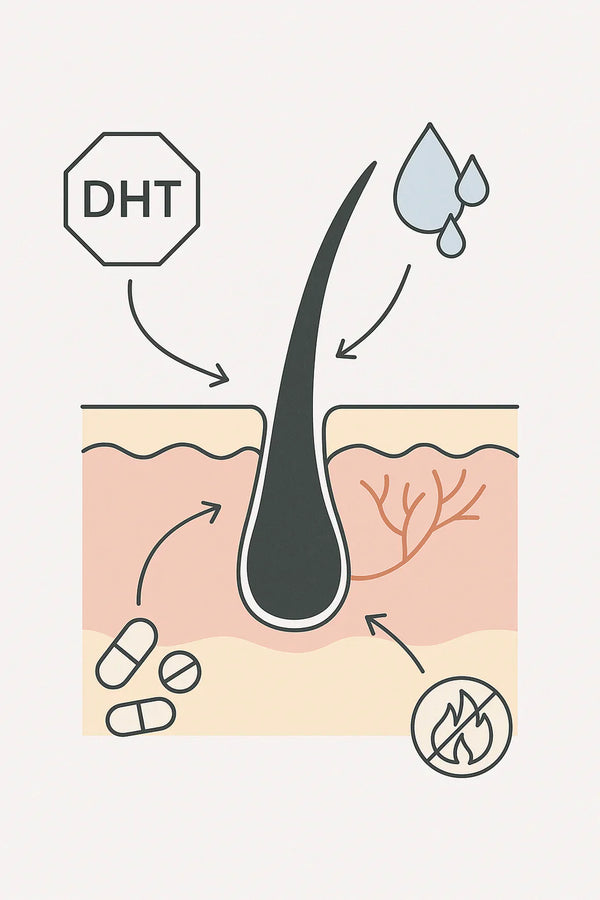
Both forms work the same way. Finasteride is a 5-alpha-reductase inhibitor (5-ARI): it inhibits the conversion of testosterone into dihydrotestosterone (DHT). In men with a hereditary predisposition, a high DHT level makes hair follicles shrink, so the hair gets thinner and falls out. By lowering the DHT level, finasteride can help slow this process, as long as you keep using it.
The difference isn't in how it works, but in how it's administered: a tablet you swallow versus a liquid you apply to the scalp. That form of administration determines how much of the medicine ends up in the bloodstream — and that's where the two forms diverge.
Is oral finasteride stronger than topical?
Not necessarily. A topical formula can be prepared with a higher concentration of finasteride and in that sense be "stronger". But strength on paper says little: an oral tablet contains exactly 1 mg of finasteride, while with topical application not all of the active ingredient reaches the hair follicles.
When swallowed, oral finasteride first has to pass through the digestive system and is partly broken down in the liver before it reaches the hair follicles. With topical application, part is lost instead during absorption through the skin. Because the two forms are processed so differently, it's hard to compare their strength one-to-one.
Is topical finasteride just as effective?
There is more research into oral finasteride, but the data on topical finasteride is growing. A 2021 phase III study of men aged 18 to 40 with mild to moderate hereditary baldness compared a 0.25% topical finasteride spray with oral finasteride and a placebo (Piraccini et al., 2022). After 24 weeks, the topical finasteride users showed a similar improvement in hair count to the oral group (an average change of +20.2 versus +21.1 hairs), and both did clearly better than the placebo (+6.7 hairs).
An earlier 2009 study compared a 1% topical finasteride gel with oral finasteride in 45 men and found a significant increase in hair count in both groups after 6 months (Hajheydari et al., 2009). Long-term comparisons between the two forms are still lacking, but the available data suggest that topical finasteride can have a similar effect on hair growth.
The key difference: systemic exposure
Where the two forms really diverge is in the amount of finasteride that ends up in the bloodstream. Topical medicines are associated with lower systemic exposure, because they are applied directly to the skin instead of taken by mouth.
The research findings are not always consistent. One study found that a 0.25% topical solution suppressed DHT in the blood after one week similarly to oral finasteride (Caserini et al., 2014). The 2021 phase III study, on the other hand, found that oral finasteride lowered DHT in the blood about 20% more than the topical spray after 24 weeks — an indication that the topical form keeps more of the medicine local. Because there is no standard for the concentration or the carrier of topical finasteride, the degree of systemic exposure can differ per formula.
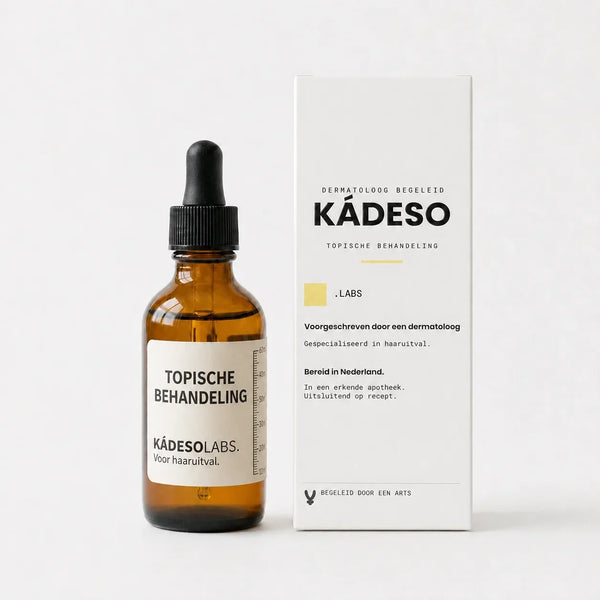
KÁDESO Labs' topical finasteride is applied directly to the scalp, in the areas where the treatment is needed. By applying it locally instead of taking a tablet, less active ingredient generally ends up in the bloodstream.
Difference in side effects of finasteride
The most discussed side effects of finasteride are sexual side effects, and mood changes are also reported. The topical form doesn't rule out side effects, but because less medicine usually reaches the bloodstream, the risk of systemic side effects may be lower; local skin irritation can occur (Lee et al., 2018).
For a full overview of the possible side effects — including sexual and psychological effects and what the research says about them — read our separate articles Side effects of finasteride and Is finasteride safe?.
Can you switch from oral to topical finasteride?
In many cases, yes. If you already use oral finasteride and want to switch to a topical formula, contact your prescribing doctor first. They will weigh your medical history and your response to the oral treatment to decide whether switching is safe.
When changing treatment, you may temporarily shed more hair because the hair follicles move into a new growth cycle. This is usually temporary. If it continues or gets worse, contact your doctor.
Which form suits you?
Oral and topical finasteride treat hair loss in the same way, and the available data suggest a similar effect on hair growth. The biggest difference lies in systemic exposure: the topical form can be attractive for the right patient if they are worried about medicine circulating through the whole body. Because topical finasteride is not approved by the CBG/EMA or the FDA and formulas differ from one another, a consultation with a doctor is essential to decide what suits you.
Topical Finasteride — ready to start? Start the free online check here →
References
Caserini, M., Radicioni, M., Leuratti, C., Annoni, O., & Palmieri, R. (2014). A novel finasteride 0.25% topical solution for androgenetic alopecia: pharmacokinetics and effects on plasma androgen levels in healthy male volunteers. International Journal of Clinical Pharmacology and Therapeutics, 52(10), 842–849.
Hajheydari, Z., Akbari, J., Saeedi, M., & Shokoohi, L. (2009). Comparing the therapeutic effects of finasteride gel and tablet in treatment of the androgenetic alopecia. Indian Journal of Dermatology, Venereology and Leprology, 75(1), 47–51.
Lee, S. W., Juhasz, M., Mobasher, P., Ekelem, C., & Mesinkovska, N. A. (2018). A Systematic Review of Topical Finasteride in the Treatment of Androgenetic Alopecia in Men and Women. Journal of Drugs in Dermatology, 17(4), 457–463.
Piraccini, B. M., Blume-Peytavi, U., Scarci, F., et al., & Topical Finasteride Study Group (2022). Efficacy and safety of topical finasteride spray solution for male androgenetic alopecia: a phase III, randomized, controlled clinical trial. Journal of the European Academy of Dermatology and Venereology, 36(2), 286–294.
Yanagisawa, M., Fujimaki, H., Takeda, A., Nemoto, M., Sugimoto, T., & Sato, A. (2019). Long-term (10-year) efficacy of finasteride in 523 Japanese men with Androgenetic Alopecia. Clinical Research and Trials, 5(5).
Legal disclaimer. The content of this article and the KÁDESO Labs blog is intended for educational purposes only. It is not a substitute for medical advice. Topical finasteride is not approved by the CBG/EMA for hair loss and is supplied exclusively through a Dutch doctor and pharmacy, for adults. Always consult a qualified healthcare provider for matters relating to your health.
Want to try topical finasteride under a doctor's supervision? Book a one-time intake with Prof. dr. Sherief Janmohamed, dermatologist and hair loss expert at KADESOLABS.