Hair loss is an emotional and confusing subject for many men. Yet baldness in men is one of the most common conditions in the world: an estimated more than half of all men over 50 deal with noticeable hair loss.[1] In this article we explain what the causes are, how baldness develops and — more importantly — what you can do about it.
What causes baldness in men?
The most common form of hair loss in men is called androgenetic alopecia, better known as male pattern baldness. This is a hereditary condition in which the hair on the crown and temples gradually thins and eventually disappears.
The main cause is the hormone DHT (dihydrotestosterone), a by-product of testosterone made by the enzyme 5-alpha-reductase. In men with a genetic sensitivity, DHT binds to androgen receptors in the hair follicles, causing follicular miniaturisation.[2] The hair growth cycle is disrupted: the hair becomes thinner, shorter and eventually growth stops completely.
Besides genetic predisposition and DHT, age, hormonal changes and environmental factors also play a role. Studies show that the prevalence of androgenetic alopecia increases significantly with age: from about 16% in men in their twenties to more than 50% in men over fifty.[1]
The stages of male pattern baldness: the Hamilton-Norwood scale
To classify the severity of hair loss, dermatologists use the Hamilton-Norwood scale. This scale, standardised by Norwood in the 1970s, divides male pattern baldness into seven stages.[3]
- Stage I-II: Minimal recession of the hairline at the temples. Barely visible yet.
- Stage III: Clear recession at the temples and/or beginning thinning on the crown. This is the earliest stage at which treatment is most effective.
- Stage IV-V: Further recession of the hairline and expansion of the bald spot on the crown. An increasingly narrow bridge of hair separates the two areas.
- Stage VI-VII: The hairline and bald crown have merged. Only a horseshoe-shaped band at the sides and back remains.
The sooner you recognise and treat hair loss, the better the chance of keeping your current hair. So don't wait until the baldness is advanced.
Proven treatments for male pattern baldness
Finasteride: the scientifically backed choice
Finasteride is currently the most researched and proven effective treatment for androgenetic alopecia in men. Its mechanism of action targets the cause: finasteride inhibits the enzyme 5-alpha-reductase type II, reducing the production of DHT by more than 60%.[4]
In a landmark randomised controlled trial by Kaufman et al. (1998), published in the Journal of the American Academy of Dermatology, oral finasteride 1 mg/day over a two-year period led to significant hair growth in 83% of participants and prevented further hair loss in virtually all participants.[5]
Topical finasteride: local action, reduced systemic exposure
A promising development is topical finasteride: a solution applied directly to the scalp. Research shows that topical application leads to a significant reduction of DHT in the scalp tissue, with reduced systemic absorption compared with oral administration.[6]
A study by Piraccini et al. (2022), published in JAMA Dermatology, compared topical finasteride 0.25% twice daily with oral finasteride 1 mg/day. The results showed comparable effectiveness on hair density, while the systemic DHT reduction was significantly lower in the topical group.[7] This means a reduced chance of systemic side effects compared with oral finasteride.
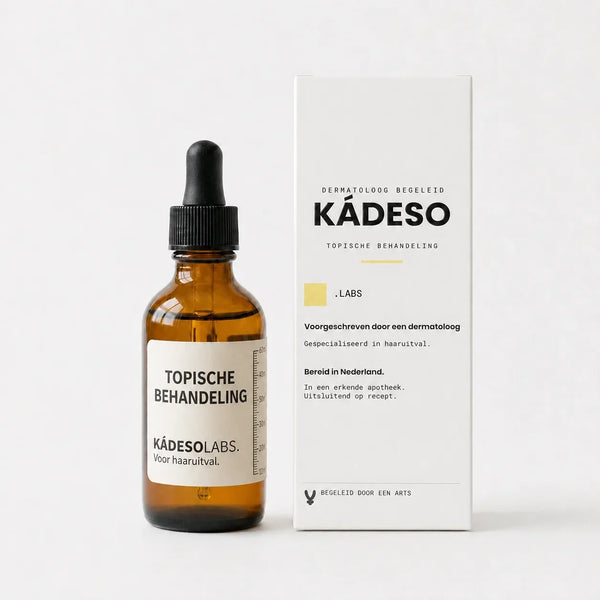
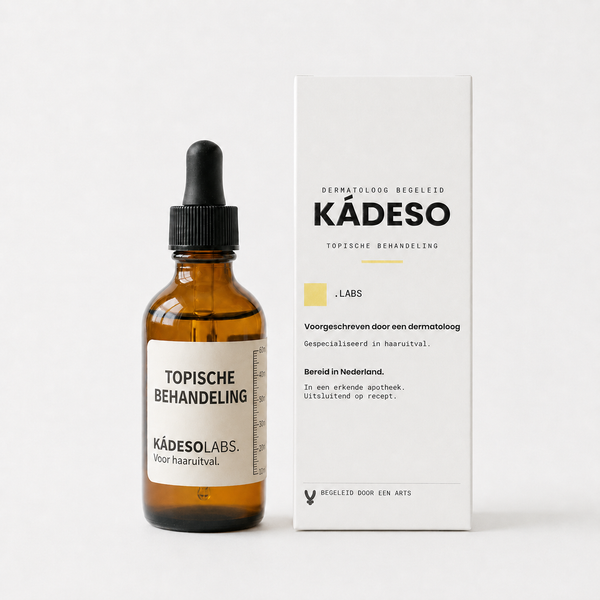
At KADESOLABS, topical finasteride is prescribed by Prof. dr. Sherief Janmohamed, dermatologist specialised in hair loss. The treatment is always tailored personally to your situation. View the topical finasteride from KADESOLABS.
Minoxidil
Minoxidil is a vasodilator that is applied topically and stimulates hair growth by extending the anagen phase of the hair cycle. Combined with finasteride, the results are usually better than with monotherapy.[8] However, minoxidil does not target DHT and therefore doesn't tackle the underlying cause of androgenetic alopecia.
Side effects of finasteride
As with any medicine, there are potential side effects. The most reported side effects of oral finasteride concern sexual function (reduced libido, erectile dysfunction) and are usually reversible after stopping treatment.[9] The incidence in randomised studies is low: in the pivotal study by Kaufman et al., sexual side effects were reported in 3.8% of the finasteride group versus 2.1% in the placebo group.[5]
Topical finasteride has the potential advantage of a reduced chance of systemic side effects thanks to more limited systemic absorption. Want to know more? Read our in-depth article on the side effects of finasteride.
Frequently asked questions
Can baldness be reversed?
In most cases not completely. Treatment with finasteride can stop further hair loss and in many cases stimulate hair regrowth, but baldness that has been present for years responds less well to treatment. Acting early gives the best results.
From which stage does treatment make sense?
Treatment is most effective from Hamilton-Norwood stage II-III. The more hair still present, the more there is to keep. With advanced baldness (stage VI-VII), expectations should realistically be tempered.
How long does it take for finasteride to work?
Most men see the hair loss decrease after 3-6 months. Visible hair regrowth usually occurs after 6-12 months. Consistent daily application is essential for lasting results.
Conclusion
Baldness in men is a common, scientifically well-understood condition with effective treatment options. DHT is the driving force behind androgenetic alopecia, and finasteride - especially in topical form - is the most evidence-based intervention to stop and reverse this process.
At KADESOLABS, your treatment is personally supervised by Prof. dr. Sherief Janmohamed, one of the most respected dermatologists in the Netherlands in the field of hair loss. View our topical finasteride and start a treatment that works today.
References
- Norwood OT. Incidence of male androgenetic alopecia. Dermatol Surg. 2001;27(9):781-784. PubMed 11493313
- Sawaya ME, Price VH. Different levels of 5alpha-reductase type I and II, aromatase, and androgen receptor in hair follicles of women and men with androgenetic alopecia. J Invest Dermatol. 1997;109(3):296-300. PubMed 9284093
- Norwood OT. Male pattern baldness: classification and incidence. South Med J. 1975;68(11):1359-1365. PubMed 1188424
- Gormley GJ, et al. The effect of finasteride in men with benign prostatic hyperplasia. N Engl J Med. 1992;327(17):1185-1191. PubMed 1383816
- Kaufman KD, et al. Finasteride in the treatment of men with androgenetic alopecia. J Am Acad Dermatol. 1998;39(4):578-589. PubMed 9777765
- Blume-Peytavi U, et al. A randomized double-blind placebo-controlled pilot study to assess the efficacy of a 24-week topical treatment by latanoprost 0.1% on hair growth and pigmentation in healthy volunteers with androgenetic alopecia. J Am Acad Dermatol. 2012;66(5):794-800. PubMed 22153793
- Piraccini BM, et al. Efficacy and safety of topical finasteride 0.25% vs oral finasteride 1 mg in androgenetic alopecia: A randomized clinical trial. JAMA Dermatol. 2022;158(3):278-285. PubMed 35080596
- Hu R, et al. Combined treatment with oral finasteride and topical minoxidil in male androgenetic alopecia: a randomized and comparative study in Chinese patients. Dermatol Ther. 2015;28(5):303-308. PubMed 26147181
- Mella JM, et al. Efficacy and safety of finasteride therapy for androgenetic alopecia: a systematic review. Arch Dermatol. 2010;146(10):1141-1150. PubMed 20956649